Contaminated Loft Insulation After Rats or Mice: Strip, Clean and Refill
Once rats or mice have been living in a loft, the insulation is usually full of droppings and urine, and often tunnelled through or turned into nests. It can't be cleaned where it lies or covered over, so it has to come out. We strip it out damp, disinfect the loft and lay new insulation once everything is dry. We don't do the pest control itself: if rats or mice are still active, a pest controller treats them first. Then we seal the entry holes we find, so new insulation doesn't just become new bedding.
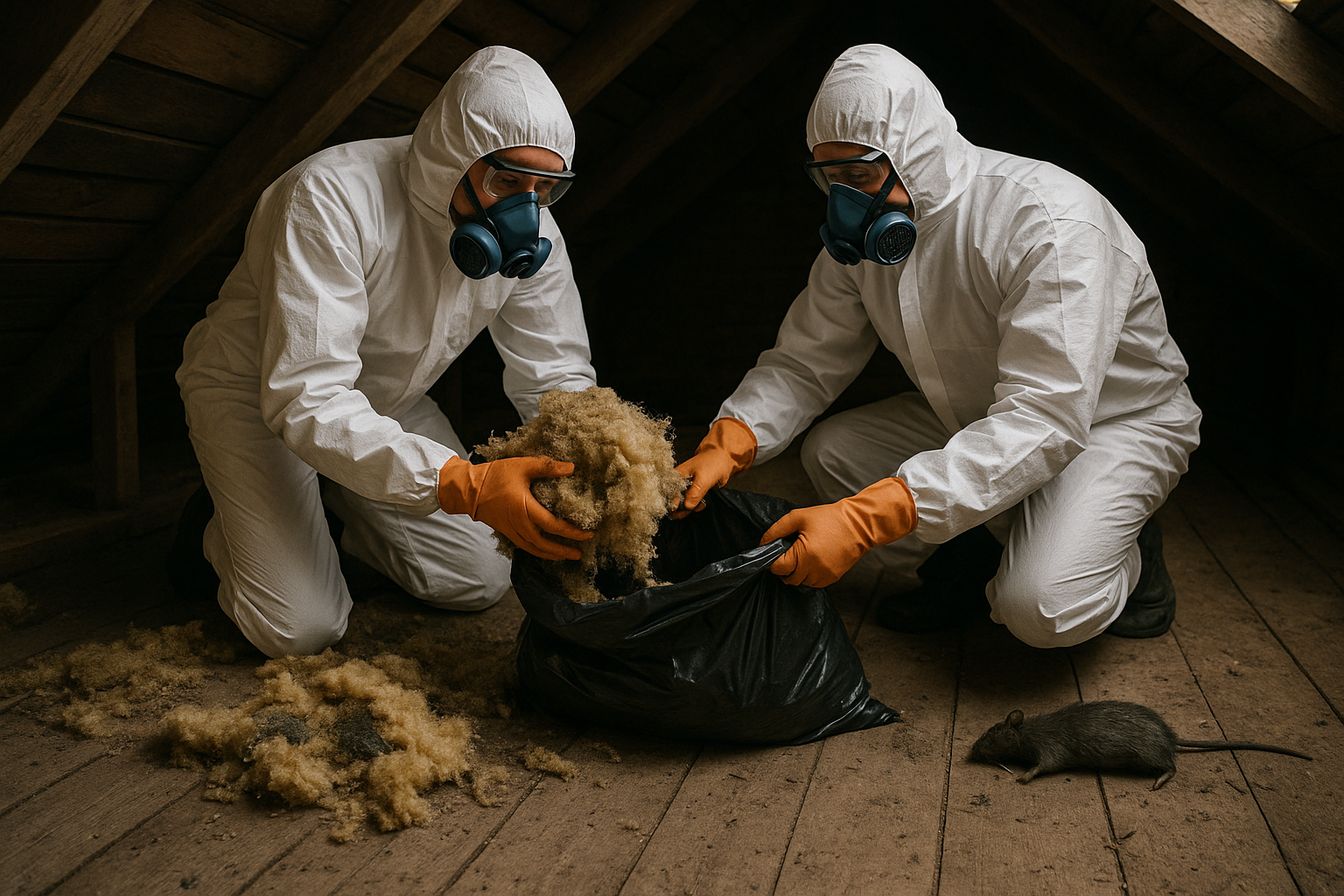
Health Risks From Rodent-Soiled Insulation
The risk comes from touching it and from breathing the dust when dried droppings and urine-soaked insulation are disturbed:
- Leptospirosis (Weil's disease): carried in rat urine and caught through cuts or through the eyes, nose and mouth. It is rare in the UK but can be serious.
- Salmonella and other gut bacteria: carried in droppings, which is why nothing from the loft should end up near food.
- Allergies and asthma: proteins in rodent urine and dander are common triggers, and the dust irritates airways.
You may read about hantavirus online; cases linked to UK rats are very rare. Serious illness from a loft is uncommon, but the dust is the reason we clear these lofts damp, in FFP3 masks, coveralls, gloves and goggles, and never dry-sweep or use a household vacuum. If you feel unwell with flu-like symptoms after handling droppings, see your GP or call NHS 111 and mention the rodents. There is more on each risk in are rat and mouse droppings dangerous?
Signs of Rats or Mice in Your Loft
Not sure what left the droppings? Our guide to rat, mouse, squirrel and bat droppings shows the difference, and there is more on rats in the loft and mice in the loft. The usual signs are:
- Droppings: rat droppings are 12 to 20mm long with blunt ends and left in groups; mouse droppings are 3 to 7mm, pointed and scattered everywhere.
- Tunnels and nests: runs through the insulation, flattened patches, and nests of shredded insulation, paper or fabric.
- Urine: dark stains and a sharp ammonia smell, strongest where they nest.
- Grease marks: dark smears on joists and beams and around the holes rats use every night.
- Gnawing: chewed timber, pipe lagging, plastic pipes and cables. Chewed or bare wires are a fire risk, so get an electrician to test the circuits.
- Noise at night: heavy scrabbling and gnawing from rats, lighter scratching and pattering from mice.
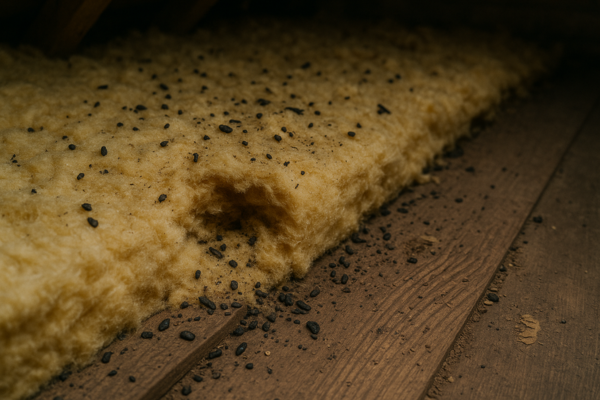
Does All the Insulation Need to Come Out?
Not always. If the droppings are confined to one corner and the insulation everywhere else is clean and dry, the soiled section can be cut out, the area disinfected and patched with new. If droppings are spread through the loft, or the insulation is urine-soaked, tunnelled or nested in, it all needs to come out, because there is no way to disinfect inside the fibres. From a couple of photos we can usually tell you which, and we will quote for the smaller job when that is all it needs. Weighing up what to refill with? See do rats eat loft insulation?
What to Do if You Find Droppings in the Loft
- Get the rats or mice dealt with first: call a pest controller to treat them and find how they are getting in.
- Don't sweep, vacuum or pull out the insulation. That is what puts the dust in the air. If it is only a few droppings on boards, here is how to clean them up safely.
- Keep the hatch shut, and keep children and pets out of the loft.
- Take a couple of photos from the hatch and send them to us for a price.
- If you have handled droppings, wash your hands thoroughly.
How We Clear a Rodent-Soiled Loft
Damp Down First
Droppings and insulation are misted before anything is disturbed. Nothing is dry-swept.
Strip and Double-Bag
Soiled insulation is bagged while it is still damp, double-bagged, and taken down through the hatch.
Vacuum
The loft is vacuumed back to the joists with an industrial M-class or H-class extractor, never a household vacuum.
Disinfect
Joists, felt and the top of the ceiling are misted with Virkon S at a 1% solution, with a heavier wetting and around ten minutes' contact time where the droppings were.
Dry and Refill
Once everything is dry, new insulation goes in to 270mm or deeper.
Where the Soiled Insulation Goes
Rodent-soiled insulation is bagged damp and double-bagged so the dust stays in, then taken away with the rest of the job's waste under a waste transfer note. If you are clearing a loft yourself, our guide on how to dispose of old loft insulation covers tips, skips and checking a waste carrier.
What a Rodent Clean-Up Costs
We price rodent clean-ups from the loft size and a couple of photos, because the cost depends on how far the droppings have spread, the depth of the old insulation, access, and whether the loft is refilled. Removal-only clear-outs start from £699, and disinfection and new insulation are priced on top. Send photos through the quote form for a written price.
Keeping Rats and Mice Out
We don't do the pest control itself: if rats or mice are still active, a pest controller needs to treat them first, and broken drains are a job for a drainage firm. Once they are dealt with, we seal the entry holes we find with mesh, and where they are getting in through the drainage we can fit a one-way valve in your own drain, as we did for Jill in Runcorn. A valve isn't a permanent fix on its own, so the drain fault still needs finding with a CCTV survey and repairing. Disinfectant cleans the loft but has no repellent effect, so sealing the way in matters as much as the clean-up. If you don't have a pest controller, we will point you to one. If rats have died up there after treatment, see dead rat smell in the loft.
How Rats and Mice Get Into Lofts
- Broken drains: the most common route and the one most often missed: an estimated 80% of rat infestations in homes start in the drains. Rats come up a defective drain or soil stack, climb inside the cavity wall and come out in the loft. Here is how the drain route works and how it is closed.
- Gaps in brickwork and mortar: a rat can get through a gap about the size of a 10p coin, a mouse through one about 10mm wide, roughly the width of a pencil.
- Air bricks with broken or missing grilles, which lead under the floor or into the cavity wall.
- Eaves, soffits and fascias where the boards have rotted or shrunk.
- Gaps around pipes and cables where they pass through the walls.
Sources: NHS: Leptospirosis (Weil's disease); UK Health Security Agency: Common animal-associated infections in England, 2025; BPCA: Drainage inspections for rodents; West Lothian Council: Proofing against rats and mice; LANXESS: Virkon S technical data sheet (Defra approval).
Recent Rodent Jobs
Three recent rodent clean-ups: rats in the walls in Runcorn, an infestation in Oldham, and a removal that turned into a decontamination.
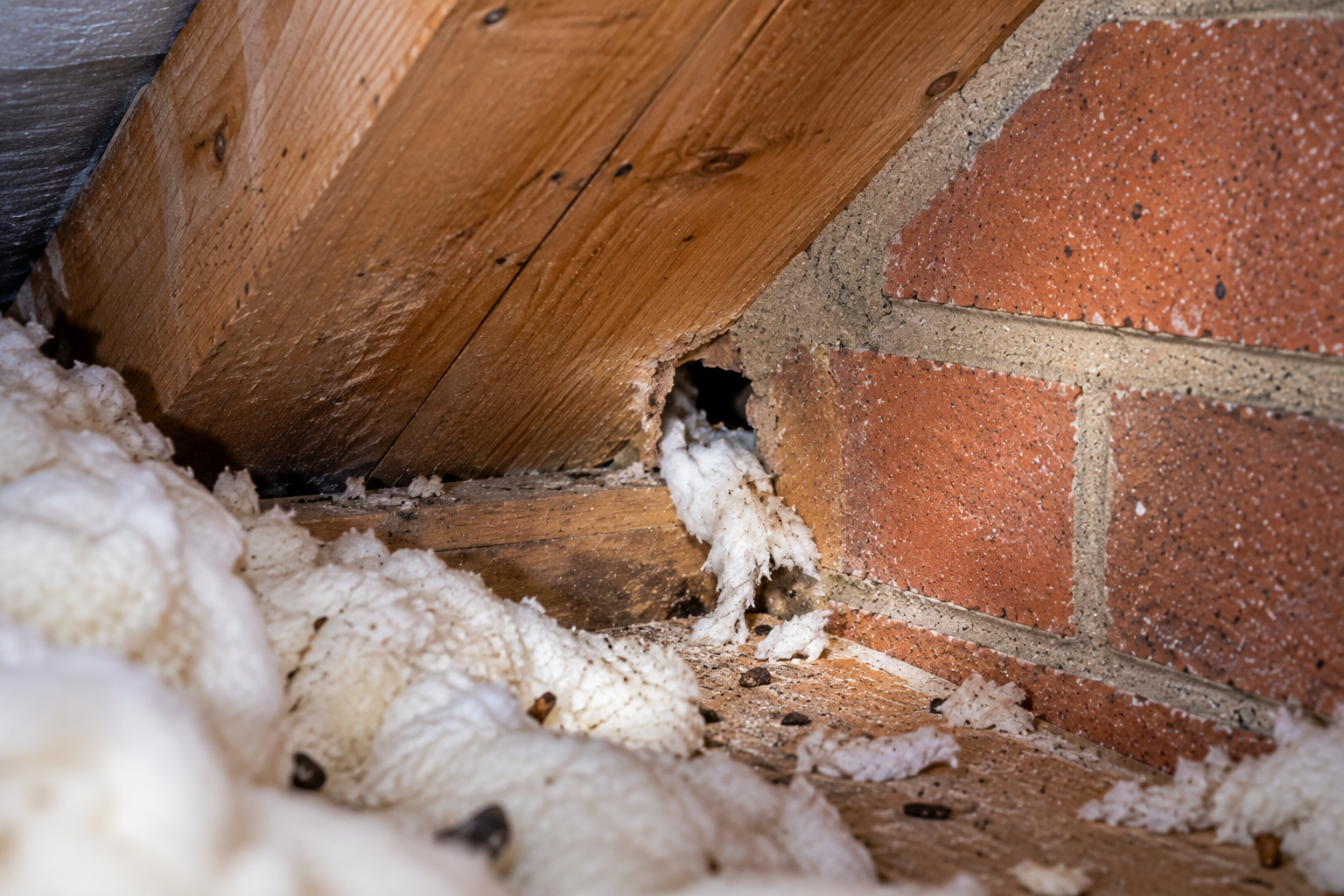
Rats in the Walls in Runcorn: Loft Cleared and Sealed
Rats climbing inside the walls: four entry holes outside and a route in through the drains. Loft cleared and decontaminated, holes meshed, one-way valve fitted.
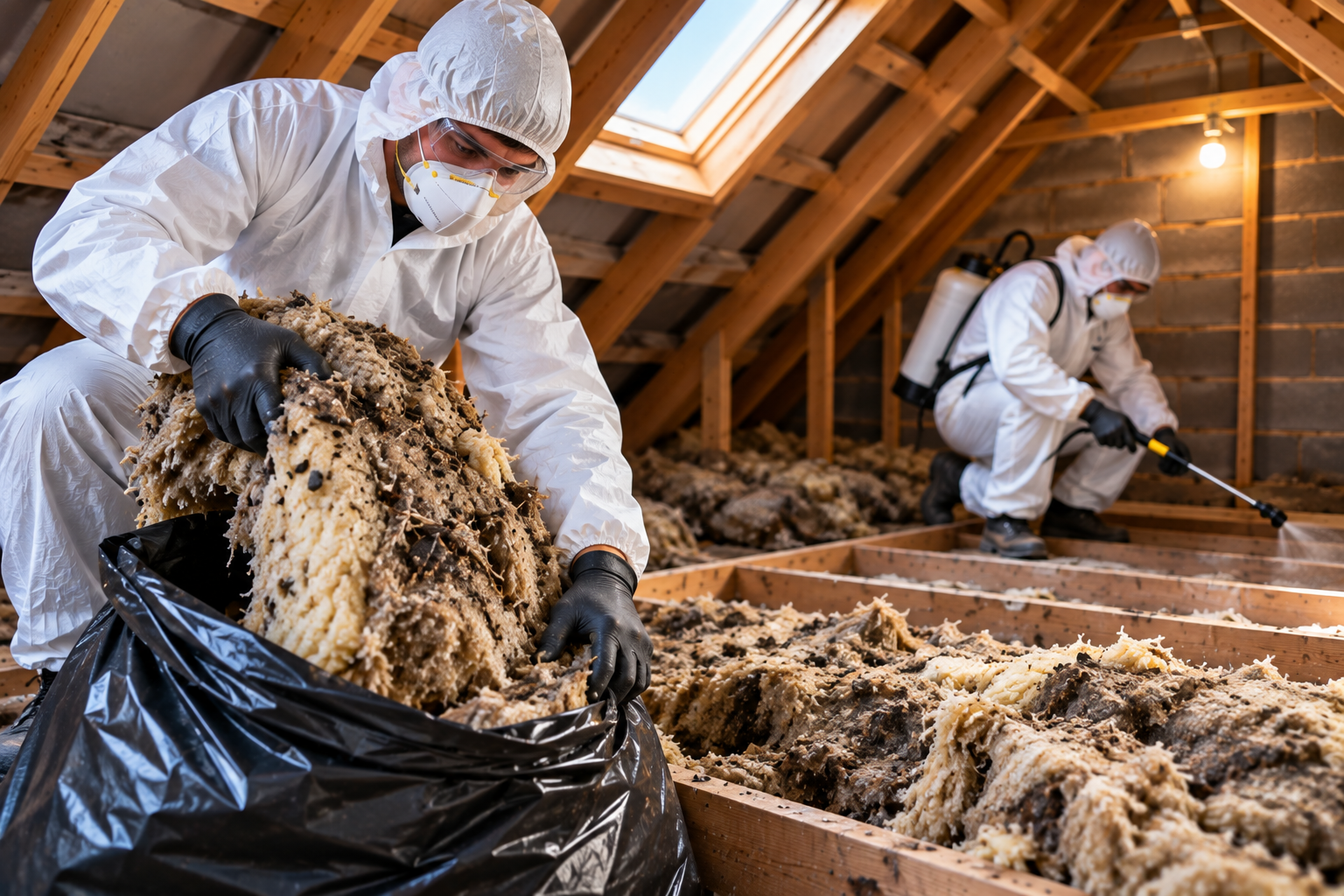
Rat-Infested Loft in Oldham: Cleared and Decontaminated
Five dead rats in the loft, all the old insulation out, the whole loft decontaminated, and the two places they were getting in filled.
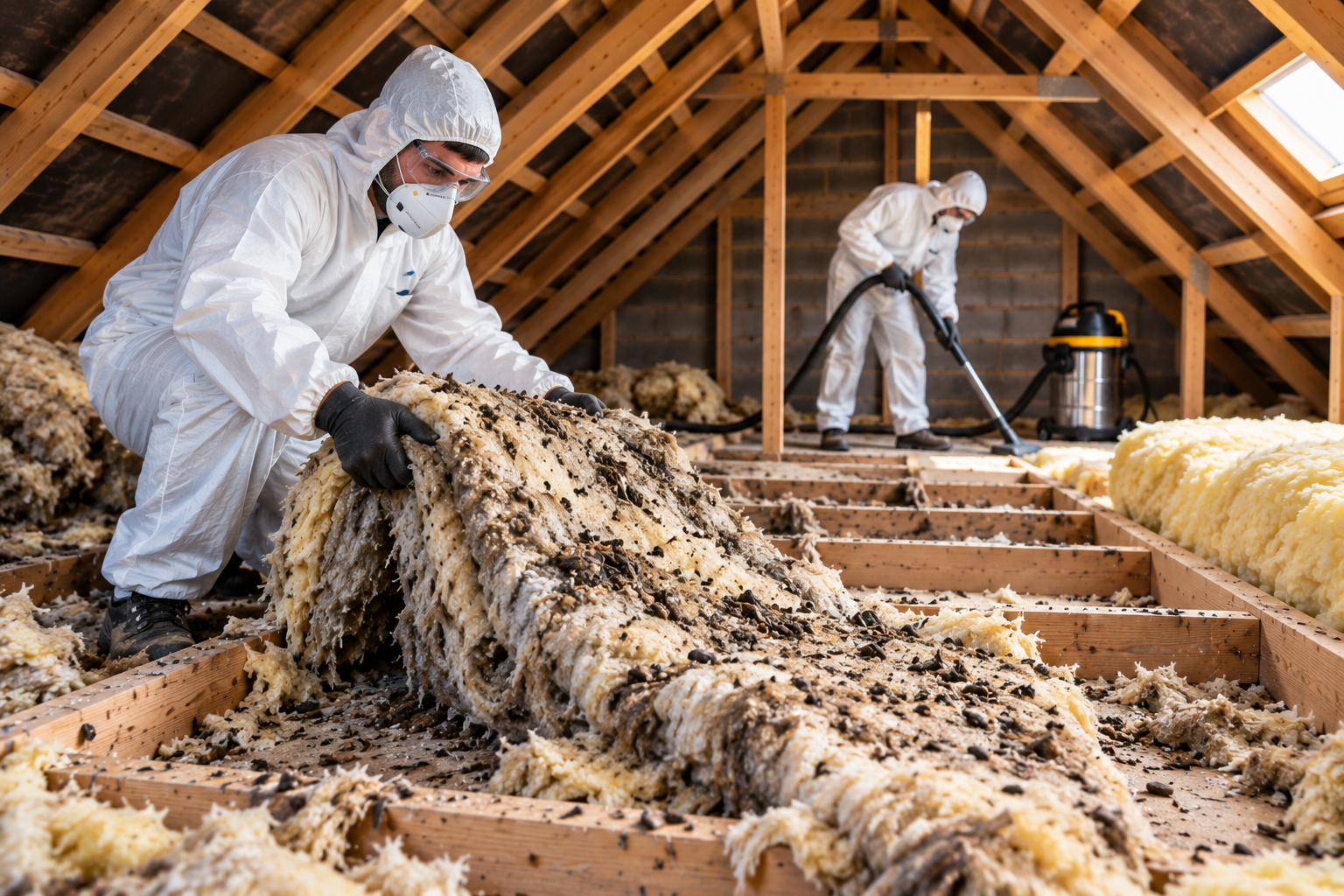
Rat-Soiled Loft Cleared and Decontaminated
Rat droppings through the old insulation turned a removal into a decontamination job: cleared damp, double-bagged and disinfected with Virkon S.
Rats and Mice in the Loft: Our Guides
Not sure what you are dealing with yet? Start here.
Areas We Cover
Based in Cheshire and working across the UK, with most rodent jobs in Greater Manchester, Merseyside and Cheshire.
Rodent-Damaged Insulation FAQs
Is rodent-soiled loft insulation dangerous?
It can be. Rat urine can carry leptospirosis (Weil's disease), droppings can carry salmonella, and rodent urine and dander are common allergy and asthma triggers. The risk comes from touching it and breathing the dust when it is disturbed, which is why it should be cleared damp and in proper PPE, not swept or vacuumed.
Do I need to replace all the insulation after rats or mice?
Not always. If the droppings are confined to one area, the soiled section can be cut out, the area disinfected and patched with new. If they are spread through the loft, or the insulation is urine-soaked or nested in, it all needs to come out.
Should I get pest control before you come?
If they are still active, yes: the rats or mice need treating first, and we don't do pest control ourselves. Once they are dealt with, we clear and disinfect the loft and seal the entry holes we find, so new insulation doesn't just become new bedding.
What do you use to disinfect the loft?
Virkon S, a Defra-approved disinfectant, at a 1% solution (two tablets per litre). It is misted over the joists, felt and ceiling tops, with a heavier wetting and around ten minutes' contact time where the droppings were, and the loft is left to dry fully before new insulation goes in.
How much does a rodent clean-up cost?
It depends on how far the droppings have spread, the loft size, access and whether you want it refilled. Removal-only clear-outs start from £699, and disinfection and new insulation are priced on top. Send a couple of photos through the quote form for a written price.
Will my home insurance pay for it?
Check your policy wording first, because many home insurance policies exclude damage caused by vermin. If you do claim, we can supply before and after photos of the loft and an itemised invoice.
Do you cover my area?
Yes. We are based in Cheshire and work across the whole of the UK. Most of our rodent clean-ups are in Greater Manchester, Merseyside and Cheshire; see the areas we cover for local pages.
Do you need to visit before you can give a price?
Usually not. A couple of photos from the loft hatch are normally enough to tell whether it needs a small cut-out and patch or a full clear-out, and we come back with a written price.
Will the rats come back after the clean-up?
They can if a way in is still open, because disinfectant cleans the loft but doesn't repel them. We mesh the entry holes we find. If rats keep coming back after that, the drains are the usual route, and a CCTV drain survey finds the fault so a drainage firm can repair it.