Short answer: Mouse droppings are small (3 to 7mm), thin and pointed, and scattered everywhere. Rat droppings are much bigger (12 to 20mm), thick with blunt ends, and left in groups. Grey squirrel droppings sit in between at around 8 to 10mm, rounder and often lighter brown. Bat droppings look like mouse droppings but crumble into powder when rolled, and if that is what you have, stop and get advice before anything in the loft is touched.
How to Tell Loft Droppings Apart
Size is the quickest guide, then shape, then where they are. Wear gloves if you need a closer look, and don't pick droppings up or crush them with bare hands.
| Droppings | Size | Shape and colour | Where you find them |
|---|---|---|---|
| Mouse | 3 to 7mm, about a grain of rice | Thin, pointed at the ends, dark when fresh | Scattered widely along joists and runs and through the insulation |
| Brown rat | 12 to 20mm, about an olive stone | Thick and sausage-shaped with blunt ends | In groups near runs, nests and the way in |
| Grey squirrel | About 8 to 10mm | Rounder and barrel-shaped, often lighter brown | Near the eaves and a bulky nest of shredded insulation |
| Bat | 4 to 8mm | Like mouse droppings, but they crumble to powder with shiny flecks | Piled under where bats hang, on beams, stuck to walls and felt |
The black rat, the other rat species you may read about, is almost unknown in British houses today, so in a UK loft large droppings nearly always mean the brown rat.
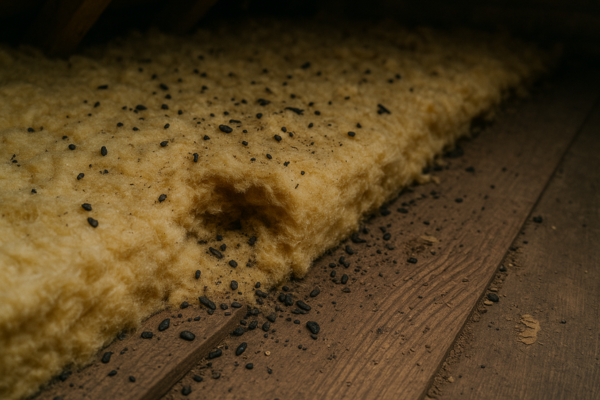
Mouse Droppings
Mouse droppings are small, thin and pointed, about the size of a grain of rice. Mice drop them as they move, up to around 80 a day by pest controllers' counts, so even two or three mice spread them right across a loft: along the joists, over the insulation, in stored boxes and around the hatch. Fresh ones are dark and slightly shiny; older ones go dull and grey.
Mice also leave small spots of urine, and in a loft they have lived in for a long time you may find small greasy mounds where urine, grease and dirt have built up in one place. Shredded insulation, paper or fabric balled up near the eaves or above a warm ceiling is usually the nest. If it is mice, our guide to mice in the loft covers what to do next.
Rat Droppings
Brown rat droppings are much bigger: 12 to 20mm long, thick, with blunt ends, roughly the size of an olive stone. A rat leaves fewer than a mouse, up to around 40 a day, but they are left in groups along the routes rats use and close to where they nest. Rats also leave dark grease smears on timber and around holes they use every night, and tunnels through the insulation that you can often see from the hatch.
Rats in a loft nearly always have a way in from below, very often a fault in the drains, so finding that route matters as much as the treatment. Our guides to rats in the loft and rats in the walls go through both.
Squirrel Droppings
Grey squirrel droppings are around 8 to 10mm, rounder than a rat's with rounded ends, and often lighter brown. They are easy to confuse with rat droppings, so look at the other signs as well. Squirrels are active in the day, so the noise is thumping and running in the early morning and evening rather than in the middle of the night. They get in high up, at the eaves, fascias and gaps in the roof, and they build a big, untidy nest from shredded insulation.
Squirrels are rodents too: they chew timber, cables and pipe lagging, and soil the insulation around the nest. Getting rid of them is a pest controller's job, and it is illegal to release a grey squirrel once it has been caught.
Bat Droppings: Stop and Get Advice
Bat droppings are 4 to 8mm long, so they are easily mistaken for mouse droppings. The difference is what they are made of. Bats eat insects, so dry bat droppings crumble into a fine powder full of shiny flecks of wing when you roll one with a stick or a gloved finger. Old rodent droppings can dry out and break, but they break into hard, dull pieces and never turn to that glittery powder.
Bat droppings tend to collect in a pile under the spot where the bats hang, on the tops of beams and along the ridge, or stuck to the walls and roofing felt. A lot of droppings found in summer, with no chewing anywhere, is a reason to think of bats before rodents.
All UK bats and their roosts are protected by law, and a roost is protected even when the bats are away. Fitting or removing loft insulation can disturb bats or damage a roost, so if you think you have bat droppings, leave everything as it is and call the National Bat Helpline on 0345 1300 228. Bats don't chew wiring, insulation or timber, so a loft with bats in it often doesn't need clearing at all. If we find signs of bats on a job, work stops until you have that advice.
Bird Droppings and Old Nests
White, chalky splashes near the eaves, with twigs, straw or feathers, are birds rather than rodents. Starlings and sparrows often nest in the eaves. All wild birds, their nests and eggs are protected under the Wildlife and Countryside Act 1981, so an active nest has to be left until the young have flown. After that, the gap they used should be blocked so they don't come back next spring.
Are They Fresh or Old?
Fresh rodent droppings are dark, slightly shiny and soft. Over the following days and weeks they dry out, go dull and turn grey. To find out whether rodents are still active, take a photo of a patch of boards or insulation near the hatch, leave it alone, and look again a few days later with the photo to compare. That tells you without disturbing anything.
New droppings, fresh gnawing or noise at night mean they are still there and pest control comes first. Nothing new for a couple of weeks after treatment usually means the clean-up can be booked.
What to Do Once You Know
- Bats: stop, leave the loft alone and call the National Bat Helpline.
- Rats or mice still active: get them treated by your council or a pest controller first. We don't do pest control ourselves.
- Leave the droppings where they are: don't sweep, vacuum or pull out the insulation. Here is why the dust matters, and how to clean up a few droppings safely if that is all there is.
- Send us photos from the hatch: we will tell you whether it needs a small cut-out and patch or a full clear-out, and send a written price for the rodent-damaged loft insulation removal.
More Rodent Guides
Everything else we have written about rats and mice in the loft, and the clean-up service itself.
Areas We Cover
Based in Cheshire and working across the UK, with most rodent jobs in Greater Manchester, Merseyside and Cheshire.
Loft Droppings FAQs
What do rat droppings look like?
Brown rat droppings are 12 to 20mm long, thick and sausage-shaped with blunt ends, roughly the size of an olive stone. They are dark when fresh and are found in groups along the routes rats use and near their nest.
What do mouse droppings look like?
Mouse droppings are 3 to 7mm long, thin and pointed at the ends, about the size of a grain of rice. Mice leave a lot of them and scatter them widely, so they turn up all over a loft rather than in one place.
How can I tell bat droppings from mouse droppings?
Roll one with a stick or a gloved finger. Dry bat droppings crumble into a fine powder with shiny flecks of insect wing; mouse droppings stay hard. Bat droppings also pile up under where the bats hang. If you think they are bat droppings, leave the loft alone and call the National Bat Helpline on 0345 1300 228, because bats and their roosts are protected.
Are old droppings still dangerous?
They can be. Dried droppings and urine can still carry bacteria and allergens, and old ones are more likely to turn to dust when disturbed. Treat old droppings the same as fresh ones: damp them down with disinfectant before touching them, and never sweep or vacuum them.
Do I need new insulation if I find droppings?
Not always. A few droppings on boards can be cleaned up. If they are in one corner of the insulation, that section can be cut out and patched. If they are spread through the loft, or the insulation is urine-soaked or nested in, it needs to come out and the loft disinfected before it is refilled. See how a rodent clean-up works.