In short: if rats or mice have been in your Liverpool loft, get them treated first (the council does this free for most homes), then have the soiled insulation stripped out damp, the loft disinfected, the entry holes sealed and the insulation refilled. Removal-only clear-outs start from £699, and we give a written price from a couple of photos taken at the loft hatch.
Liverpool City Council treats rats and mice in homes free of charge, and its pest team baits the sewers too, so getting the rodents dealt with is usually the easy part. The loft is another matter. Once rats or mice have been living in the insulation, it is soiled with droppings and urine and can't be cleaned where it lies. We clear it out, disinfect the loft and refill it. Liverpool is about an hour from our Cheshire base.
Why Rats and Mice Get Into Liverpool Lofts
Liverpool has street after street of Victorian terraces, in Anfield, Walton, Kensington, Kirkdale, Everton, Wavertree, Toxteth and the Dingle, alongside the large Victorian houses around Sefton Park and Aigburth, and the interwar and post-war semis of Allerton, Childwall, West Derby, Norris Green and Woolton.
- Terraced rows. Roof spaces along a terrace aren't always fully divided, so rodents can move from one loft to the next.
- Old drains. An estimated 80% of rat infestations in homes start in the drains. The council baits the public sewers, but a broken private drain under a house can still let rats into the cavity wall and up to the loft; see rats in the walls.
- The river and the canal. The Mersey waterfront and the Leeds and Liverpool Canal in the north of the city both have their rats.
- Big old houses. The large Victorian houses around Sefton Park and Aigburth have big lofts and plenty of ways in at the eaves.
Rats and mice move indoors most in autumn and winter, when it turns cold and food outside gets scarce, so autumn and winter are when most people first notice them. A loft is warm, dry and quiet, and the insulation makes ideal nesting material. By the time you hear them, they have usually been up there for a while.
Signs You Have Rats or Mice in the Loft
Most people in Liverpool find out from the noise first: scratching or scurrying above the bedroom ceiling, usually at night or in the early morning. Other signs to look for from the hatch:
- Droppings on the boards, joists or the top of the insulation. Rat droppings are 12 to 20mm long with blunt ends, about the size of an olive stone; mouse droppings are 3 to 7mm and pointed, about the size of a grain of rice. Our guide to droppings in the loft shows the difference.
- Tunnels and flattened runs through the insulation, and nests of shredded insulation, paper or cardboard, often near the eaves or the water tank.
- Gnawing on timber, pipe lagging, stored boxes and, most seriously, electrical cables, which is a fire risk.
- A strong ammonia smell from urine, or a sweet, rotten smell if rodents have died after treatment. See dead rat smell in the loft.
- Dark greasy smears along joists, rafters and around holes, where rats rub as they run.
Try not to go poking around in the insulation. Droppings and urine carry bacteria, and disturbing them dry puts dust in the air. Our guide on whether rat droppings are dangerous covers the real health risks, including Weil's disease, and when to see a GP.
Liverpool Homes and the Loft Problems We See
Nearly four in ten Liverpool households (38%) live in a terraced house, against 23% across England, and another 31% live in a semi, according to the 2021 Census. The type of house makes a real difference to how rodents get in and how the clean-up goes.
Two-up two-down terraces
The small terraces of Anfield, Walton, Kirkdale, Everton, Toxteth and the Dingle have tight roof spaces and small hatches, often with the insulation laid at different depths over the years. Where the party wall stops short of the roof, rodents can move along the whole row, and when one house is treated and the neighbours aren't, they can come straight back. If you are in a terrace, it is worth talking to the houses either side and getting the row treated at the same time. The back entries, or jiggers, with their bins and old drains, give rats plenty of cover right up to the back wall.
Bay-fronted terraces and big Victorian houses
In Wavertree, Kensington, Aigburth, Mossley Hill and around Sefton Park, the houses are bigger, with deeper lofts and more eaves to get in at. Many of the large Victorian houses have been split into flats, and the loft above them is usually a shared part of the building. If that is your home, the freeholder or managing agent normally arranges the clean-up, so tell them in writing.
Inter-war and post-war semis
In Allerton, Childwall, West Derby, Woolton, Norris Green and Fazakerley, lofts are a good size and rats most often get in at the eaves, through broken air bricks or up the cavity from a broken drain. The droppings can be spread right across the loft, which is why we price from photos rather than a flat rate.
Near the waterfront and the canal
Homes near the Mersey, the docks and the Leeds and Liverpool Canal in the north of the city are close to where brown rats live. The council baits the public sewers, but a broken private drain under your own house isn't part of that. If you keep getting rats back after treatment, the drains are the first thing to check. A fault in your own drain is yours to fix, while a shared sewer or a pipe beyond your boundary is for United Utilities. Our guide to rats in the walls explains how they climb up from a broken drain and how a one-way valve stops them.
Council Pest Control in Liverpool
Liverpool City Council treats rats, inside or outside the home, and mice inside the home, free of charge for the people living in individual homes. A course of treatment is up to two visits, or up to three if rats are inside the property, and the follow-up should be within a calendar month of the first booking. The council aims to treat within five working days, or within 24 hours for rats inside the home, but rats in the loft are left out of the 24-hour target and come under the five days.
- Booking is online. You sign in or create an account on the council's website. Visits are arranged by ward and day of the week, and you need to book by 12pm the day before the council visits your area.
- Someone over 18 must be in. Visits are between 9am and 3.30pm, and the council can't give a set time.
- The person living there books it. A family member or social worker can book with the occupier's consent, but a landlord or letting agent can't.
- Not straight after another treatment. The council can't attend if another pest controller has treated the problem in the last month.
- Shared houses aren't covered. For HMOs, shared student houses and the communal parts of flats, the landlord has to arrange a commercial visit.
- No squirrels. The home service treats rats, mice, ants and wasps only, so grey squirrels in the loft need a private pest controller.
The council baits the public sewers as well. In a pilot reported in August 2026, its pest control team went door to door with enforcement and Streetscene officers around Pagebank Road and Pilch Lane, visiting more than 350 homes, and found that many people with pests had never reported them. The council says it relies on those reports to know where the problems are, so if you have rats or mice, book the visit.
The council deals with the rodents, not the soiled insulation, and it only removes dead rodents where it is practicable to do so. The loft clean-up is the part we do once the treatment has finished.
Who Does What
| Job | Who does it |
|---|---|
| Treating rats and mice in your home | Liverpool City Council pest control (free for people living in individual homes), or a private pest controller |
| Grey squirrels in the loft | A private pest controller (the council doesn't treat squirrels) |
| Shared houses, HMOs and the communal parts of flats | The landlord books a commercial pest control visit |
| Public sewers | The council baits them; repairs are for United Utilities |
| A broken private drain under your house | A drainage firm |
| Stripping out soiled insulation, disinfecting the loft | Loft Restore |
| Sealing entry holes with mesh, one-way valves on your own drain | Loft Restore, once the rodents have gone |
| Refilling the loft to 270mm or deeper | Loft Restore |
When to Book the Clean-Up
Book us once the council or your pest controller is happy the rodents have gone, which is usually at the end of the course of visits. Liverpool City Council collects any bait boxes it lays on its follow-up visit, and you mustn't put them in your own bin, so leave them where they are until then. If you are still hearing them or finding fresh droppings, wait: new insulation laid while rodents are active will just get soiled again. You can send us photos while the treatment is under way, so the price is ready and the job can be booked as soon as you are clear.
How We Clear a Rodent-Soiled Loft in Liverpool
Every Liverpool job starts the same way: send a couple of photos from the loft hatch through the quote form and we will come back with a written price. On the day, the work follows the same five steps as our main rodent-damaged loft insulation removal service.
Damp Down First
Droppings and insulation are misted before anything is disturbed. Nothing is dry-swept, so the dust stays down.
Strip and Double-Bag
Soiled insulation is bagged while it is still damp, double-bagged, and taken down through the hatch and out to the van.
Vacuum
The loft is vacuumed back to the joists with an industrial M-class or H-class extractor, never a household vacuum.
Disinfect and Seal
Joists, felt and the top of the ceiling are misted with Virkon S, and the entry holes we find are sealed with mesh.
Dry and Refill
Once everything is dry, new insulation goes in to 270mm or deeper, and we send photos of the finished loft.
Most terraced and semi-detached lofts in Liverpool are cleared in a day; big Victorian lofts and heavily soiled ones can take two. The soiled insulation is taken away with the rest of the job's waste under a waste transfer note. If you are clearing a loft yourself, our guide on how to dispose of old loft insulation covers tips, skips and checking a waste carrier, and cleaning up droppings safely covers what to wear and which disinfectant to use.
Why You Shouldn't Just Top Up Over the Droppings
It is tempting to lay a fresh roll over the top and forget about it, and it is the cheaper option on the day. The problem is that the droppings, urine and any dead rodents are still there underneath. The smell can come back on warm days, the soiled patches hold moisture, and if the rodents ever return they have a ready-made nest. Rats and mice also tunnel through every type of loft insulation, so no product will keep them out on its own; our guide to whether rats eat loft insulation explains why. Strip out, disinfect, seal the way in, then refill: that is the order that works.
What a Rodent Clean-Up Costs in Liverpool
We price every job from the loft size and a couple of photos, because the cost depends on how far the droppings have spread, the depth of the old insulation, how easy the hatch is to work through, and whether the loft is refilled. Removal-only clear-outs start from £699, and disinfection and new insulation are priced on top. You pay the balance at the end of the job, once you have checked the loft.
Recent Rodent Clean-Ups Near Liverpool
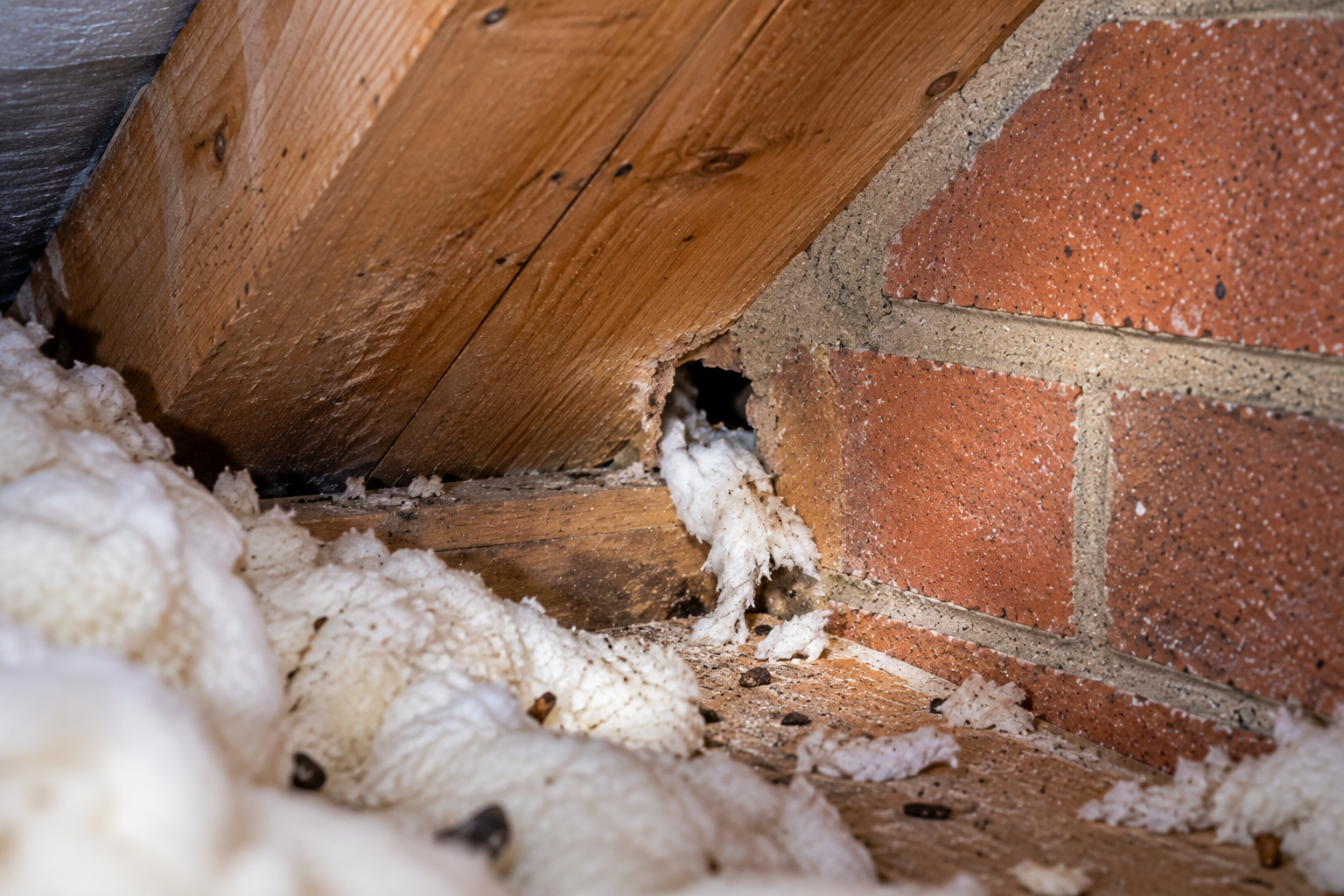
Rats in the Walls in Runcorn: Loft Cleared and Sealed
Rats climbing inside the walls: four entry holes outside and a route in through the drains. Loft cleared and decontaminated, holes meshed, one-way valve fitted.
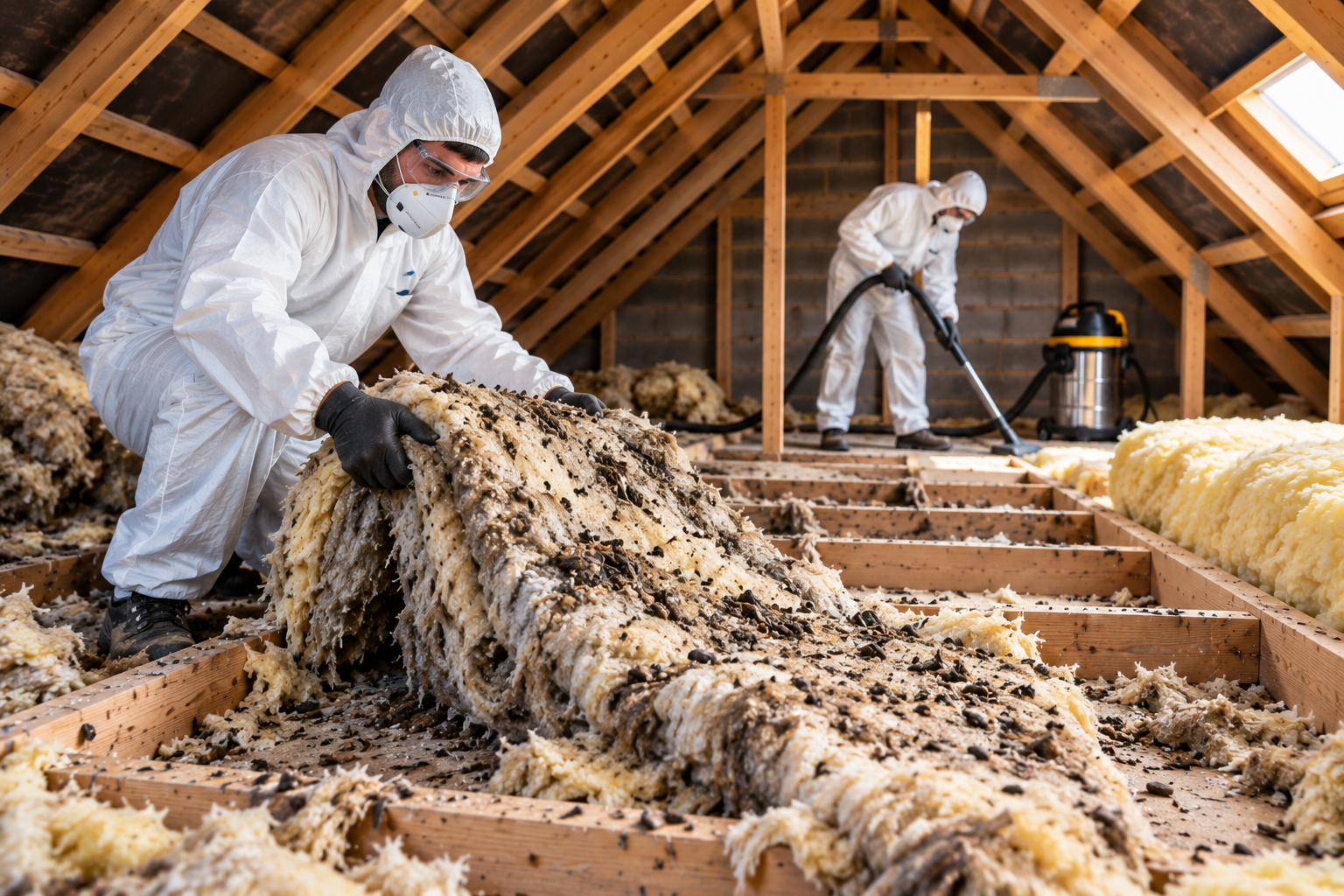
Rat-Soiled Loft Cleared and Decontaminated
Rat droppings through the old insulation turned a removal into a decontamination job: cleared damp, double-bagged and disinfected with Virkon S.
Landlords, HMOs and Flats in Liverpool
If you rent, tell your landlord as soon as you notice signs of rodents, and book the free council visit yourself: the council takes the booking from the person living in the home, or from a family member or social worker with their consent, but not from a landlord or letting agent. The loft clean-up and refill are normally for the landlord to arrange, as is any repair to the way in, such as a broken drain or a hole in an outside wall. In a shared house or HMO, including the student lets around Kensington, Wavertree and Smithdown Road, it works the other way round: the free service doesn't cover shared houses, so the landlord has to book a commercial pest control visit and arrange any work on the loft.
If you own a flat in a converted house, the loft is usually a shared part of the building, so the freeholder or managing agent arranges the work. Landlords, agents and managing agents can send us photos from a tenant or a visit, and we can work with the occupants to arrange access. We supply photos of the cleared and refilled loft and an itemised invoice for your records.
Areas We Cover in Liverpool
- City Centre (L1, L2, L3)
- Anfield and Walton (L4, L9)
- Everton and Kirkdale (L5)
- Kensington and Fairfield (L6, L7)
- Edge Hill (L7)
- Wavertree (L15)
- Toxteth and the Dingle (L8)
- Aigburth (L17, L19)
- Mossley Hill and Sefton Park (L17, L18)
- Allerton (L18)
- Childwall (L16)
- Woolton and Gateacre (L25)
- West Derby (L12)
- Old Swan and Tuebrook (L13)
- Knotty Ash and Broadgreen (L14)
- Norris Green and Croxteth (L11)
- Fazakerley (L9, L10)
- Garston and Speke (L19, L24)
We cover the rest of Merseyside too, including Knowsley, Sefton, St Helens and the Wirral, and further up the Mersey in Runcorn and Widnes and Warrington.
Sources
- Liverpool City Council: Book a domestic pest control visit
- Liverpool City Council: Pest control terms and conditions
- Liverpool Express: Pilot scheme tackles pests and waste issues (August 2026)
- ONS: Census 2021, accommodation type
- BPCA: Drainage inspections for rodents
- United Utilities: Sewers and drains explained
Rodent Guides
Not sure what you are dealing with yet? Start here.
Other Areas We Cover
We work across the whole of the UK. These are the areas where most of our rodent jobs are.
Liverpool Rodent Clean-Up FAQs
Is council pest control free in Liverpool?
For rats and mice, yes, if you live in an individual home: Liverpool City Council treats rats inside or outside the home, and mice inside it, free of charge, with up to two visits, or three if rats are inside. It doesn't cover shared houses, HMOs or the communal parts of flats, where the landlord books a commercial visit, and ants and wasps are charged.
How do I book Liverpool City Council pest control?
Online, by signing in or creating an account on the council's website, by 12pm the day before the council visits your area. Visits are between 9am and 3.30pm, and someone over 18 has to be in. A family member or social worker can book for you with your consent, but a landlord or letting agent can't.
Does Liverpool City Council deal with squirrels in the loft?
No. Its home service treats rats, mice, ants and wasps only, so grey squirrels need a private pest controller. Squirrels usually get in high up, at the eaves and fascias, so those gaps need sealing once they have gone.
The council treats rats for free in Liverpool. Do I still need you?
For the rats, no: the council or a private pest controller deals with them. For the loft, yes. The council doesn't strip out soiled insulation, disinfect the loft or refill it, and that is what we do.
Do you cover the Wirral, Sefton and Knowsley?
Yes. We work across the whole of Merseyside and the rest of the UK.
I live in a shared house. What should I do?
In a shared house or HMO, the landlord has to book a commercial pest control visit, and any work on the loft is for them to arrange. Let them know in writing.
How far do you travel?
We work across the whole of the UK. Liverpool is about an hour from our base in Cheshire.
How much does a rodent loft clean-up cost in Liverpool?
Removal-only clear-outs start from £699. Disinfection and new insulation are priced on top, depending on the size of the loft, how far the droppings have spread and the depth of the old insulation. Send a couple of photos from the hatch and we will come back with a written price.
How soon after the council visit can you clear the loft?
Once the council or your pest controller is happy the rodents have gone, which is usually at the end of the course of visits. If you are still hearing scratching or finding fresh droppings, the treatment needs to finish first, or new insulation will just get soiled again.
I own a flat in a converted house. Who sorts the loft?
In most converted houses the loft is a shared part of the building, so the freeholder or managing agent normally arranges the work. Let them know in writing, and they can send us photos for a price.
Can I just lay new insulation over the top?
We don't recommend it. The droppings, urine and any dead rodents stay in the loft under the new layer, the smell can come back, and soiled patches hold moisture. Stripping out and disinfecting first is the only way to get the loft properly clean.
Will my home insurance pay for the clean-up?
Many home insurance policies exclude damage caused by vermin, so check your policy wording first. If you do claim, we can supply before and after photos of the loft and an itemised invoice.
How long does the job take and do I need to be in?
Most terraced and semi-detached lofts in Liverpool are cleared in a day; big Victorian lofts and heavily soiled ones can take two. Someone needs to be at the property at the end to check the work, as the balance is paid on completion before we leave, and we can send photos of the finished loft.