In short: if rats or mice have been in your Cheshire loft, get them treated by a pest controller or your council first, then have the soiled insulation stripped out damp, the loft disinfected, the entry holes sealed and the insulation refilled. Removal-only clear-outs start from £699, and we give a written price from a couple of photos taken at the loft hatch.
We are based in Cheshire, so this is where a lot of our rodent jobs are, from terraces in Macclesfield and Crewe to farmhouses and barn conversions out in the countryside. Once rats or mice have been living in a loft, the insulation is usually soiled through with droppings and urine. We strip it out, disinfect the loft and refill it once the pest controller has dealt with them.
Why Rats and Mice Get Into Cheshire Lofts
- Rural homes. Farmhouses, cottages and barn conversions next to fields, where rats come in from farm buildings and watercourses, and wood mice move indoors each autumn.
- Big lofts. Larger detached houses in places like Wilmslow, Alderley Edge, Prestbury and Knutsford have big lofts where rodents can go unnoticed for months.
- Terraced towns. Victorian terraces in Macclesfield, built for the silk mills, in Crewe, built for the railway works, and in Chester's Hoole and Boughton, with the same shared roof spaces and old drains as any terraced street.
- Canals and rivers. The Macclesfield, Shropshire Union, Trent and Mersey and Bridgewater canals, and the Dee, the Weaver, the Bollin and the Dane.
Rats and mice move indoors most in autumn and winter, when it turns cold and food outside gets scarce, and in the countryside that move often comes straight after the harvest. A loft is warm, dry and quiet, and the insulation makes ideal nesting material. By the time you hear them, they have usually been up there for a while.
Signs You Have Rats or Mice in the Loft
Most people find out from the noise first: scratching or scurrying above the bedroom ceiling, usually at night or in the early morning. Other signs to look for from the hatch:
- Droppings on the boards, joists or the top of the insulation. Rat droppings are around the size of a grain of rice or bigger, with blunt ends; mouse droppings are much smaller and pointed. Our guide to droppings in the loft shows the difference.
- Tunnels and flattened runs through the insulation, and nests of shredded insulation, paper or cardboard, often near the eaves or the water tank.
- Gnawing on timber, pipe lagging, stored boxes and, most seriously, electrical cables, which is a fire risk.
- A strong ammonia smell from urine, or a sweet, rotten smell if rodents have died after treatment. See dead rat smell in the loft.
- Dark greasy smears along joists, rafters and around holes, where rats rub as they run.
Try not to go poking around in the insulation. Droppings and urine carry bacteria, and disturbing them dry puts dust in the air. Our guide on whether rat droppings are dangerous covers the real health risks, including Weil's disease, and when to see a GP.
Cheshire Homes and the Loft Problems We See
Cheshire has a wider mix of homes than most counties, and the type of house makes a real difference to how rodents get in and how the clean-up goes.
Farmhouses, cottages and barn conversions
Out towards Nantwich, Tarporley, Malpas, Holmes Chapel and the villages around Knutsford and Congleton, homes sit next to fields, stables, feed stores and farm buildings, all of which draw rats in. Older farmhouses and cottages tend to have more gaps in the stonework and at the eaves, and barn conversions often have small, awkward roof voids rather than a full loft. Feed bins, bird feeders and chicken runs close to the house make a big difference, so it is worth moving or sealing them once the rodents have been treated.
Big detached lofts
In Wilmslow, Alderley Edge, Prestbury, Knutsford and Poynton, lofts are large, and often partly boarded for storage. Rodents can live in the far corners for months before anyone notices, and droppings and urine soak through to the insulation under the boards. On these jobs the boards are lifted where the rodents have been, so tell us about any boarding when you send photos.
Terraced towns
The silk-town terraces in Macclesfield, the railway terraces in Crewe and the Victorian streets of Hoole and Boughton in Chester, along with older parts of Northwich, Winsford and Ellesmere Port, have the same problems as terraced streets anywhere: lofts where the party wall stops short of the roof, so rodents can move along the row, and old shared drains under the back streets. If you are in a terrace, it is worth talking to the houses either side and getting the row treated at the same time.
Canal-side and riverside homes
Cheshire has more canal than almost anywhere, and homes near the towpaths and the rivers are close to the banks where brown rats live. Rats follow water and drains, so if you keep getting them back, the drains are the first thing to check. Our guide to rats in the walls explains how they climb up from a broken drain and how a one-way valve stops them.
Council Pest Control Across Cheshire
It depends on your council. Halton Borough Council, which covers Runcorn and Widnes, provides a basic rat treatment for a charge, free for residents who receive Council Tax Reduction; free treatments are booked on 0303 333 4300. In Cheshire East and in Cheshire West and Chester, check the council's website for what is offered at the moment. Many people here use a private pest controller, ideally a BPCA or NPTA member. Warrington has its own page.
Whoever treats the rodents, the soiled insulation is a separate job, and that is the part we do.
Who Does What
| Job | Who does it |
|---|---|
| Treating rats and mice (poison, traps) | Your council's pest control where it is offered, or a private pest controller (ideally a BPCA or NPTA member) |
| Housing association homes | Your housing provider |
| Broken or defective drains | A drainage firm (or your water company if it is a shared sewer) |
| Stripping out soiled insulation, disinfecting the loft | Loft Restore |
| Sealing entry holes with mesh, one-way drain valves | Loft Restore, once the rodents have gone |
| Refilling the loft to 270mm or deeper | Loft Restore |
When to Book the Clean-Up
Book us once your pest controller or the council is happy the rodents have gone, which is usually after the follow-up visit. If you are still hearing them or finding fresh droppings, wait: new insulation laid while rodents are active will just get soiled again. You can send us photos while the treatment is under way, so the price is ready and the job can be booked as soon as you are clear.
Rats in the Walls in Runcorn
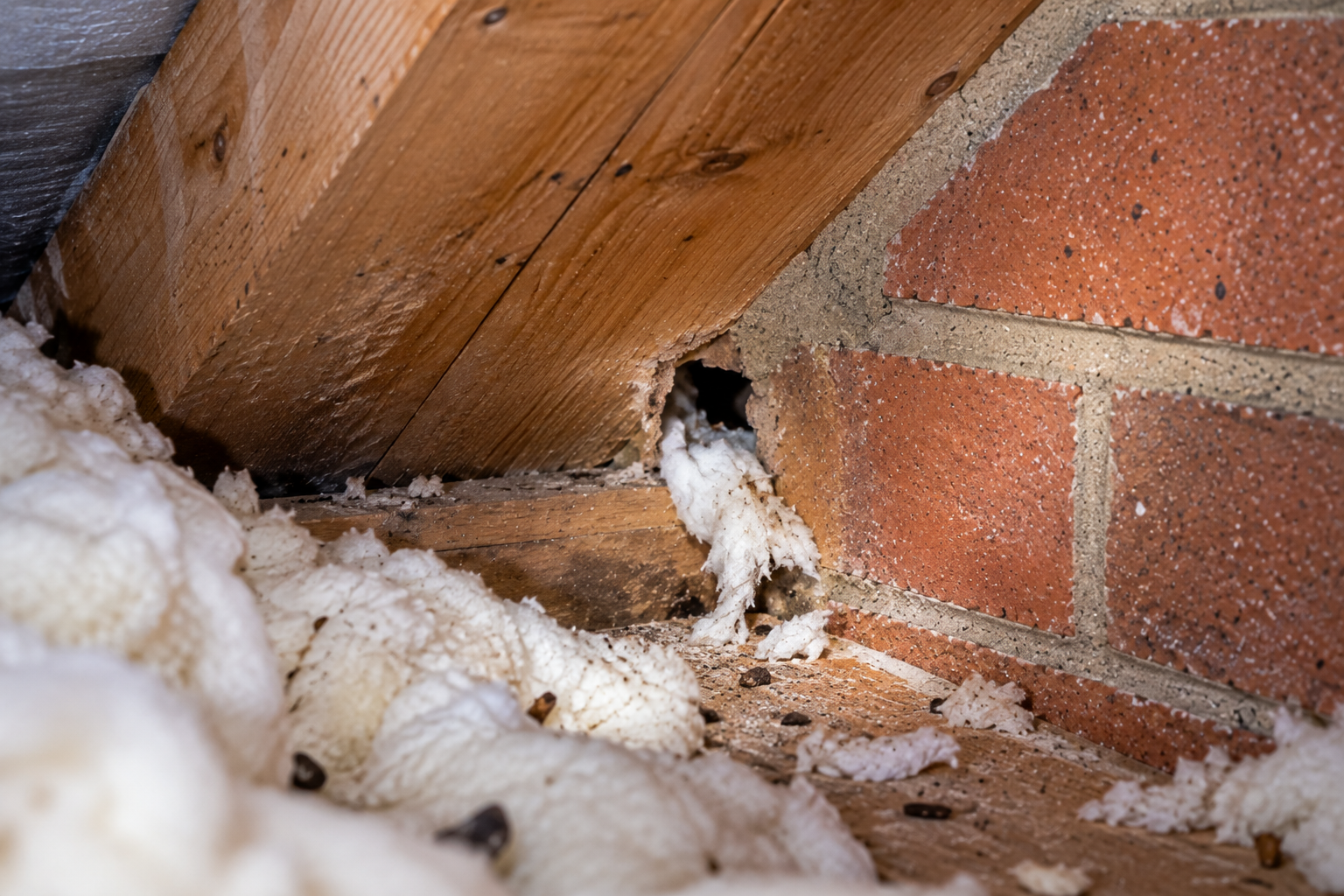
Rats were climbing inside the walls of this Runcorn house and into the loft, through four entry holes outside and a route in from the drains. We visited the next day, meshed the holes, fitted a one-way valve on the drain, and cleared and decontaminated the loft. Our guide to rats in the walls explains how that drain route works.
How We Clear a Rodent-Soiled Loft in Cheshire
Every Cheshire job starts the same way: send a couple of photos from the loft hatch through the quote form and we will come back with a written price. On the day, the work follows the same five steps as our main rodent-damaged loft insulation removal service.
Damp Down First
Droppings and insulation are misted before anything is disturbed. Nothing is dry-swept, so the dust stays down.
Strip and Double-Bag
Soiled insulation is bagged while it is still damp, double-bagged, and taken down through the hatch and out to the van. Boards are lifted where the rodents have been.
Vacuum
The loft is vacuumed back to the joists with an industrial M-class or H-class extractor, never a household vacuum.
Disinfect and Seal
Joists, felt and the top of the ceiling are misted with Virkon S, and the entry holes we find are sealed with mesh.
Dry and Refill
Once everything is dry, new insulation goes in to 270mm or deeper, and we send photos of the finished loft.
Most terraced and semi-detached lofts are cleared in a day; large detached lofts and heavily soiled ones can take two. The soiled insulation is taken away with the rest of the job's waste under a waste transfer note. If you are clearing a loft yourself, our guide on how to dispose of old loft insulation covers tips, skips and checking a waste carrier, and cleaning up droppings safely covers what to wear and which disinfectant to use.
Why You Shouldn't Just Top Up Over the Droppings
It is tempting to lay a fresh roll over the top and forget about it, and it is the cheaper option on the day. The problem is that the droppings, urine and any dead rodents are still there underneath. The smell can come back on warm days, the soiled patches hold moisture, and if the rodents ever return they have a ready-made nest. Rats and mice also tunnel through every type of loft insulation, so no product will keep them out on its own; our guide to whether rats eat loft insulation explains why. Strip out, disinfect, seal the way in, then refill: that is the order that works.
What a Rodent Clean-Up Costs in Cheshire
We price every job from the loft size and a couple of photos, because the cost depends on how far the droppings have spread, the depth of the old insulation, whether boards need lifting, how easy the hatch is to work through, and whether the loft is refilled. Removal-only clear-outs start from £699, and disinfection and new insulation are priced on top. You pay the balance at the end of the job, once you have checked the loft.
More of Our Rodent Clean-Ups
Rat-Infested Loft in Oldham: Cleared and Decontaminated
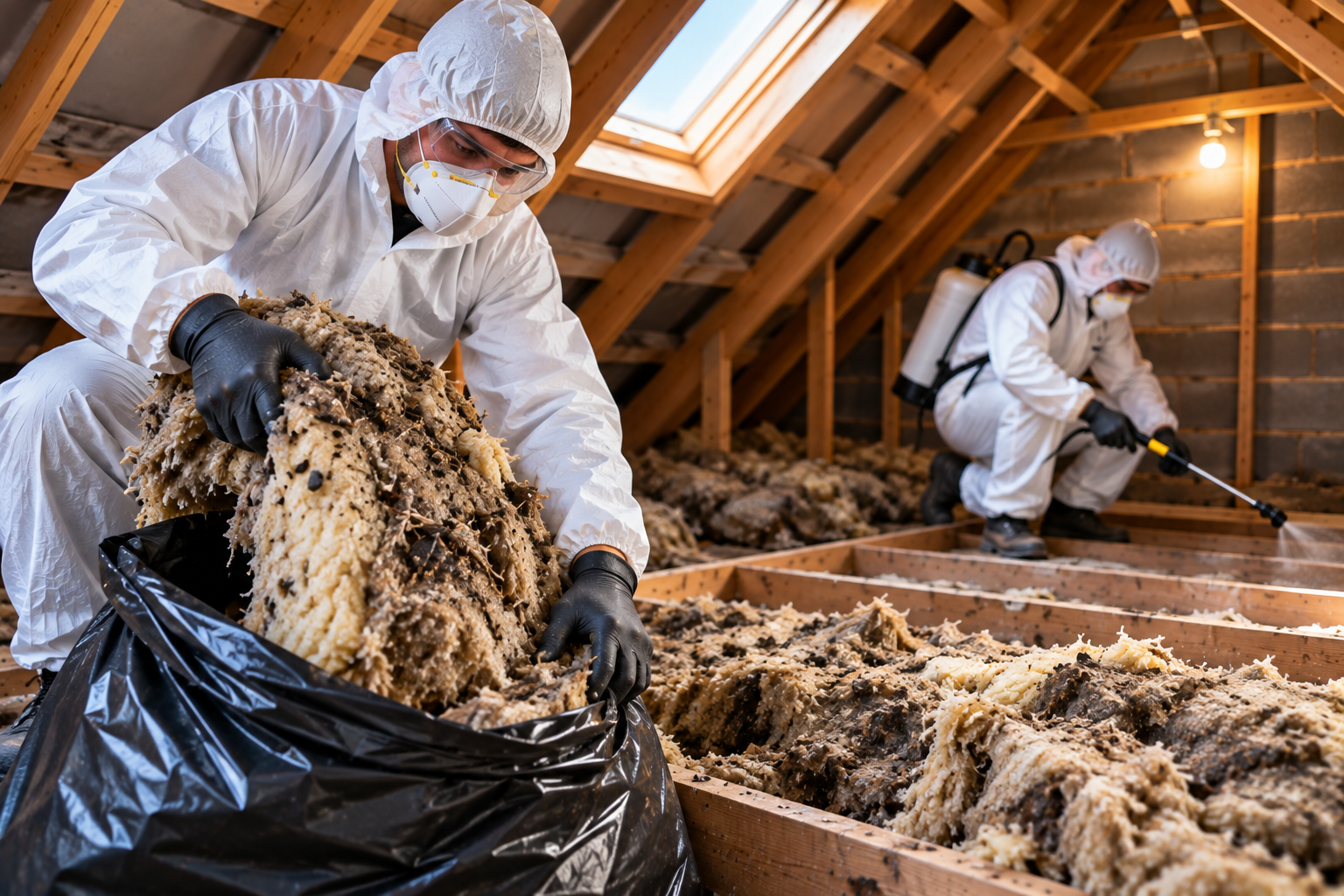
Five dead rats in the loft, all the old insulation out, the whole loft decontaminated, and the two places they were getting in filled.
Rat-Soiled Loft Cleared and Decontaminated
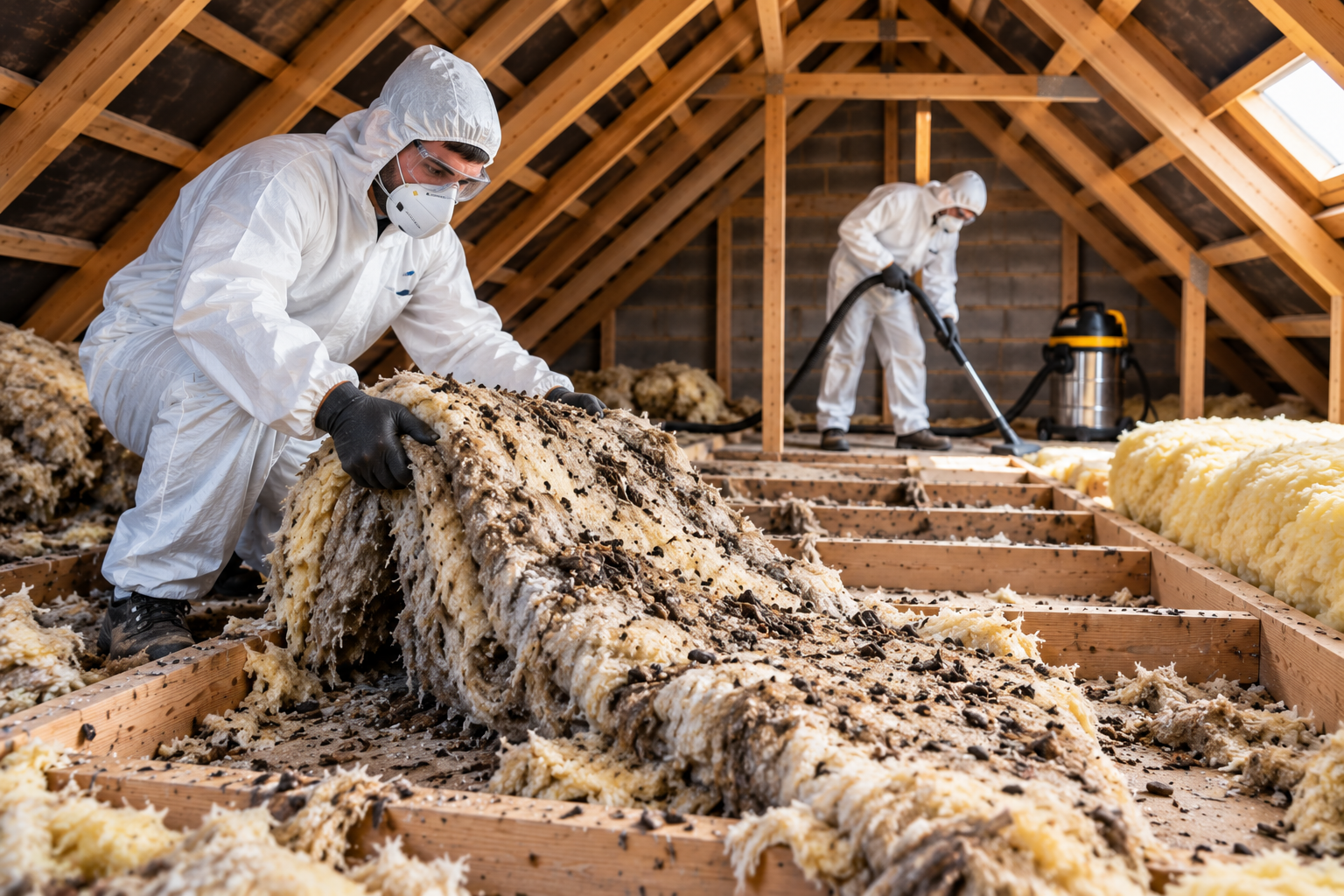
Rat droppings through the old insulation turned a removal into a decontamination job: cleared damp, double-bagged and disinfected with Virkon S.
Get a Price
Send a couple of photos from the loft hatch and we will come back with a written price.
Or email info@loftrestore.co.uk. Based in Cheshire, covering the whole county and beyond.
What We Do
- Strip out soiled insulation, damp
- Disinfect the loft with Virkon S
- Seal entry holes with mesh
- Refill to 270mm or deeper
- Photos of the finished loft
What We Don't Do
- Pest control (poison and traps): a pest controller's job
- Drain repairs: a drainage firm's job
- Asbestos or vermiculite removal
Landlords and Tenants in Cheshire
If you rent privately, tell your landlord as soon as you notice signs of rodents; the treatment and the loft clean-up are normally for the landlord to arrange. If you rent from a housing association, report it to them first, and they will arrange the pest treatment and any work on the loft.
Landlords with property in Cheshire, including holiday lets and rural cottages, can send us photos from a tenant or letting agent, and we can work with the tenant to arrange access. We supply photos of the cleared and refilled loft and an itemised invoice for your records.
Areas We Cover in Cheshire
- Macclesfield and Bollington
- Prestbury
- Wilmslow and Handforth
- Alderley Edge
- Poynton and Disley
- Knutsford
- Holmes Chapel
- Congleton
- Sandbach and Middlewich
- Crewe and Nantwich
- Alsager
- Northwich and Winsford
- Frodsham and Helsby
- Chester
- Ellesmere Port and Neston
- Runcorn and Widnes
Over the border, we also cover Stockport, Manchester and Liverpool.
Rodent Guides
Not sure what you are dealing with yet? Start here.
Other Areas We Cover
We work across the whole of the UK. These are the areas where most of our rodent jobs are.
Cheshire Rodent Clean-Up FAQs
Do you cover rural properties and barn conversions?
Yes. Farmhouses, cottages and barn conversions are a regular part of our Cheshire work. The clean-up is the same; rural lofts often have more ways in, so finding and sealing them matters even more.
Do you cover Runcorn and Widnes?
Yes. We cleared and sealed a loft in Runcorn where rats were climbing inside the walls from the drains, and it is one of our case studies.
Is it rats or mice in a country house loft?
It can be either, and wood mice come indoors in autumn as well as house mice. Rat droppings are 12 to 20mm with blunt ends; mouse droppings are 3 to 7mm and pointed. Our guide to droppings in the loft covers squirrels and bats too.
Where are you based?
In Cheshire. We work across the whole of the UK, but Cheshire, Greater Manchester and Merseyside are where most of our rodent jobs are.
How much does a rodent loft clean-up cost in Cheshire?
Removal-only clear-outs start from £699. Disinfection and new insulation are priced on top, depending on the size of the loft, how far the droppings have spread, the depth of the old insulation and whether any boarding needs lifting. Send a couple of photos from the hatch and we will come back with a written price.
How soon after pest control can you clear the loft?
Once your pest controller or the council is happy the rodents have gone, which is usually after the follow-up visit. If you are still hearing scratching or finding fresh droppings, the treatment needs to finish first, or new insulation will just get soiled again.
My loft is boarded for storage. Can you still clear it?
Yes. Droppings and urine soak through to the insulation under the boards, so the boards are lifted where the rodents have been, the insulation underneath is cleared and the joists disinfected. Let us know about boarding when you send photos, as it affects the price.
What if the droppings might be from bats?
Stop and don't disturb anything. Bats and their roosts are protected by law, and rural Cheshire lofts are exactly where they turn up. Bat droppings crumble to dust when pressed, rodent droppings don't; our guide to droppings in the loft shows the difference. If in doubt, get advice before any work goes ahead.
Can I just lay new insulation over the top?
We don't recommend it. The droppings, urine and any dead rodents stay in the loft under the new layer, the smell can come back, and soiled patches hold moisture. Stripping out and disinfecting first is the only way to get the loft properly clean.
Will my home insurance pay for the clean-up?
Many home insurance policies exclude damage caused by vermin, so check your policy wording first. If you do claim, we can supply before and after photos of the loft and an itemised invoice.
How long does the job take and do I need to be in?
Most terraced and semi-detached lofts are cleared in a day; large detached lofts and heavily soiled ones can take two. Someone needs to be at the property at the end to check the work, as the balance is paid on completion before we leave, and we can send photos of the finished loft.