Short answer: Make sure the rats or mice have gone, put on gloves and a mask, soak the droppings and any urine with disinfectant and leave it for the contact time on the label, then wipe it up with paper towels, double-bag it, disinfect the area again and wash your hands. Never sweep or use a household vacuum. If droppings are through the loft insulation, the insulation has to come out; it can't be cleaned where it lies.
Before You Start
- Make sure they have gone. If rats or mice are still active, get them treated first, or you will be cleaning up after them again next week.
- Check it is not bats. If the droppings crumble into powder, stop: bats and their roosts are protected. Our guide to identifying droppings in the loft explains the test.
- Air the space for half an hour first if you can: open windows, or in a loft, leave the hatch and any roof window open.
- Keep children and pets well away until you have finished.
What You Need
- Disposable rubber or nitrile gloves.
- A well-fitted FFP3 mask for anything in a loft or more than a handful of droppings. A paper dust mask is not enough.
- Goggles or safety glasses.
- A disinfectant: a veterinary disinfectant such as Virkon S made up to a 1% solution, or household bleach at 1 part to 10 parts water. Never mix bleach with other cleaning products.
- A spray bottle, paper towels, and strong bin bags, two per load.
- Old clothes you can put on a hot wash, or disposable coveralls.
Step by Step
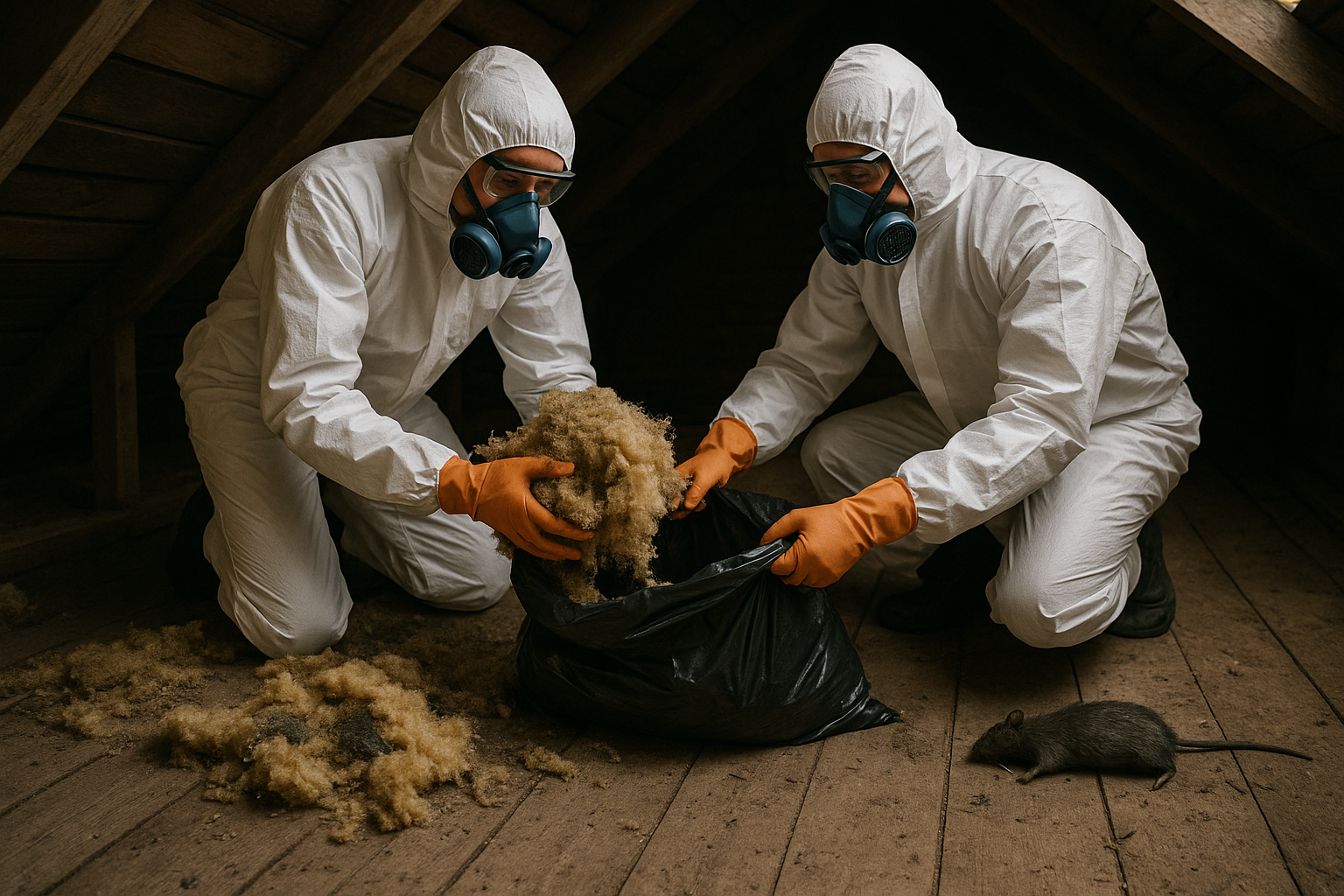
- Put on your gloves, mask and goggles.
- Spray the droppings, urine stains and any nesting material until they are thoroughly wet. Don't brush them first.
- Leave the disinfectant to work for the contact time on the label, at least five to ten minutes.
- Pick everything up with paper towels and put it straight into a bin bag.
- Spray the area again and wipe it down with fresh paper towels.
- Tie the bag, put it inside a second bag and tie that too.
- Spray or wipe your gloves with disinfectant before taking them off, then wash your hands thoroughly with soap and warm water.
- Wash the clothes you wore on a hot wash.
Small amounts of bagged droppings and nesting material can usually go in your general waste bin, not the recycling. For anything bigger, such as soiled insulation, see our guide on how to dispose of old loft insulation.
Cleaning Up Urine
Rodent urine soaks into whatever it lands on. On hard surfaces, wet it with disinfectant, leave it for the contact time and wipe it up. Bare timber can be disinfected and left to dry, but the smell may take a while to go, and airing the space helps. Insulation, cardboard and fabric that are soaked in urine can't be cleaned properly and should be bagged and thrown away.
What Not to Do
- Don't sweep or brush droppings.
- Don't use a household vacuum. It blows the fine dust straight back out into the room. Professional clean-ups use an industrial M-class or H-class extractor, and only after everything has been damped down.
- Don't pull soiled insulation out dry.
- Don't touch droppings with bare hands, even old ones.
- Don't lay new insulation over the top of droppings.
Cleaning Things Stored in the Loft
Hard plastic boxes, suitcases and other wipeable items can be sprayed with disinfectant, left for the contact time, and wiped clean. Cardboard boxes and soft items with droppings or urine on them are usually best thrown away. Fabrics that can go in the washing machine should go on the hottest wash the label allows. Do this outside or on a protected surface, not on the kitchen table.
When It Is a Job for a Professional
A few droppings on boards or in a garage is a careful DIY job. Call in a professional when:
- The droppings are through the loft insulation, not just on top of boards.
- The insulation is urine-soaked, tunnelled or nested in.
- There are dead rats or mice in the loft; see dead rat smell in the loft.
- The loft is large, the access is awkward, or there is no boarding to stand on.
- You are pregnant, or have asthma or a weakened immune system. Here is why that matters.
Soiled insulation can't be disinfected inside the fibres, so it has to come out. That is the job we do: the insulation stripped out damp and double-bagged, the loft vacuumed and disinfected with Virkon S, and new insulation laid to 270mm or deeper. Removal-only clear-outs start from £699; see how a rodent-damaged loft insulation clean-up works.
More Rodent Guides
Everything else we have written about rats and mice in the loft, and the clean-up service itself.
Areas We Cover
Based in Cheshire and working across the UK, with most rodent jobs in Greater Manchester, Merseyside and Cheshire.
Cleaning Up Droppings FAQs
Can I vacuum mouse droppings?
Not with a household vacuum, which blows the fine dust back into the air. Damp the droppings down with disinfectant and wipe them up instead. Professional clean-ups use an industrial M-class or H-class extractor after everything has been damped down.
What disinfectant should I use on rat droppings?
A veterinary disinfectant such as Virkon S at a 1% solution, or household bleach diluted at 1 part to 10 parts water. Soak the droppings and leave it for the contact time on the label, at least five to ten minutes, before wiping up. Never mix bleach with other products.
Do I need a mask to clean up mouse droppings?
Yes, for anything more than a handful, and always in a loft. Use a well-fitted FFP3 mask rather than a paper dust mask, and damp everything down first so there is less dust to breathe.
How do I get rid of rat droppings once they are bagged?
Double-bag them and put them in your general waste bin, not the recycling. Larger amounts, such as soiled loft insulation, need disposing of properly: check what your local tip accepts or use a licensed waste carrier.
Can I clean the loft insulation instead of replacing it?
No. Droppings and urine get into the fibres, where no disinfectant can reach them. Soiled insulation has to come out, and the loft is disinfected before new insulation goes in.